




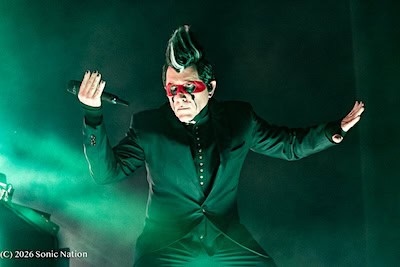
Puscifer’s stunning Thursday night concert at The Factory unfolded less like a predictable, conventional rock concert and more like a carefully staged piece of performance art—equal parts sonic exploration, sardonic humor, and theatrical precision. From the moment the lights dimmed, it was clear that this wasn’t going to be a straightforward rock show. Instead, the band leaned fully into the conceptual identity they’ve cultivated for years, blending music with character-driven storytelling, video snippets, exaggerated gestures, and a distinctly offbeat sense of satire. Even if you’ve seen Puscifer before, which many of the gathered undoubtedly had, each show is an unpredictable cinematic and live theater experience.
Before entering a darkened stage to a recording of “We Understand,” a video of Maynard reminding the audience that they had a zero-tolerance policy for cell phones, repeated on a slightly menacing loop (tough love Puscifer style). The Puscifer core (chanteuse/keyboardist, Carina Round, the enigmatic Renaissance man, vinter, and throat, the ubiquitous Maynard James Keenan; and guitarist/keyboardist Mat Mitchell), and touring members, drummer Gunnar Olsen, and bassist Josh Moreau, began to play “Self Evident,” the first single from their recent release Normal Isn’t.
The stage presence was intentionally restrained yet deeply expressive, allowing the visuals, gothic lighting, and subtle interplay between Round and Keenan to carry as much weight as the music itself. Maynard James Keenan, sporting a black suit, often positioned slightly behind the spotlight or above on the top tier of the stage, delivered vocals that were loud and clear, with controlled intensity—his voice shifting seamlessly between haunting softness and sharp-edged urgency. Keenan’s voice carries more weight and heft these days and has grown to a Sinatra-esque deep baritone. Meanwhile, Round provided the female counterpoint, the sweet to Keenan’s sour, the highs to Keenan’s lows, the light to the dark.
The 18-song setlist pulled heavily from their most recent release, Normal Isn’t, with ten tracks in total being transformed into hard-hitting and dramatic live renditions with a gothic 1980’s Bauhaus or New Orderish sheen. Tracks included opener “Thrust,” “Bad Wolf,” and even closer, “A Public Stoning,” with opener, David Hill, joining the band onstage.
Following the seventh song, “Pendulum,” there was a video titled “Bangers And Mashups,” which featured Round and Keenan as guests on an absurd UK “talk” show discussing backing holiday treats to cure depression. The short was deliberately crude, primitive, grainy, complete with 1980s Max Headroom or early MTV video glitches and hiccups. As always, Keenan’s vision is one of bizarre humor, oblique references, and a stunted reality.
Vocalist and keyboardist Carina Round proved to be an essential counterpart throughout the evening. Her vocal interplay with Keenan added emotional depth and contrast, especially during tracks like “The Humbling River” and “Seven One.” Round’s presence balanced the performance—wearing “Blade Runner”-style makeup, a beautiful red dress, and striking, curious poses, and intertwined with Maynard in a twisted St. Vitus Dance. She provided the female magic and mystique to Maynard’s typical, more macho, detached, and muscular performances with Tool.
Visually, the show maintained a minimalist but purposeful aesthetic. Lighting shifts were subtle yet effective, often mirroring the tonal changes within songs. Rather than overwhelming the senses, the production enhanced the mood—whether through cool, sterile hues during more introspective moments or warmer red tones during the set’s more rhythmic peaks.
Humor—always a key component of Puscifer’s identity—was woven throughout, though never in a way that undercut the music. Instead, it served as a counterbalance to the often introspective and philosophical themes, keeping the performance grounded and accessible. This interplay between seriousness and satire is part of what makes Puscifer’s live shows so distinctive.
The closing stretch brought a return to more structured, emotionally resonant material. “Grand Canyon” stood out as a late highlight, its expansive sound and layered vocals creating a sense of resolution. As the final notes faded, the band exited without excessive fanfare, leaving behind an atmosphere that lingered—thoughtful, slightly surreal, and unmistakably their own.
Ultimately, Puscifer delivered a performance that defied expectations in the best way possible. Rather than relying on traditional rock theatrics, they offered something more nuanced and deliberate—a show that invited the audience to listen closely, think deeply, and experience the music on multiple levels.
Puscifer continues to prove itself to be more than just an indulgent side project or exercise, and a real “band” with a cohesive sound, a unique approach, and a growing body of work that rivals Maynard’s work with Tool and A Perfect Circle. In many ways, Puscifer is the true realization of Keenan’s multi-faceted worldview, combined with the pivotal and invaluable contributions of Round and Mitchell.